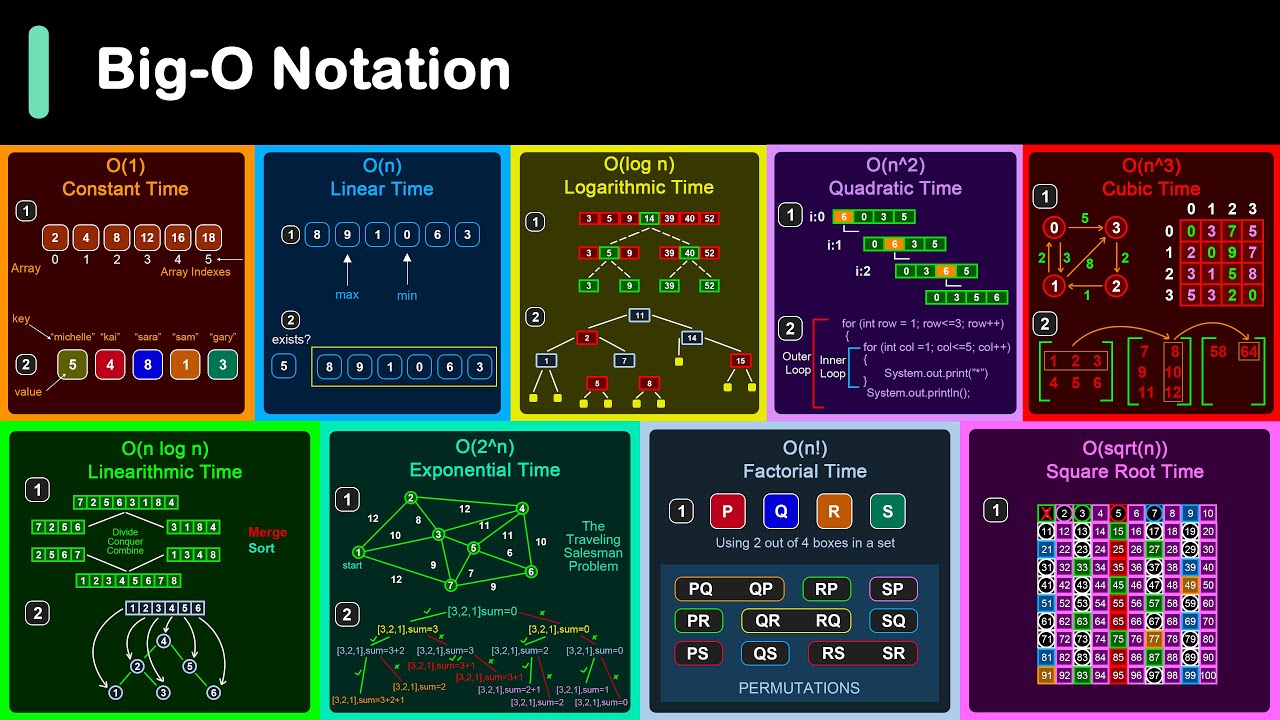
This video provides a quick overview of Big-O notation, an essential concept for assessing algorithm efficiency. It explains how runtime scales with input size and discusses various Big-O complexities from fastest to slowest. The video also emphasizes that while Big-O is a useful starting point, real-world performance may differ due to hardware specifics and memory usage optimization.
Big-O notation measures the efficiency of algorithms by describing how their runtime scales with input size, which is crucial for optimizing code performance.
The video outlines the common types of runtime complexities:
Despite the theoretical insights from Big-O notation, real-world performance can vary significantly based on additional factors such as memory usage, caching, and specific hardware conditions. For instance, traversing a 2D array row by row is faster due to better cache utilization compared to traversing it column-wise.
Array and linked list traversals both have linear time complexity, but arrays typically outperform linked lists due to caching advantages; array elements are contiguous in memory, which enhances cache hits, leading to faster access.